
GOSH Incident Reporting: Incident Trends
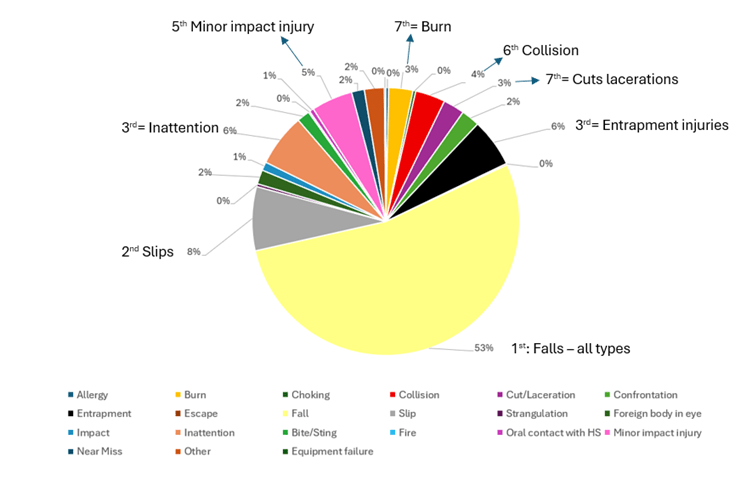
Tamariki incident trends
The categories of child injuries reported in GOSH between March (launch) to 13th June (close) at centres are shown in the pie chart above.
Slips, trips and falls
Over 60% of all reported incidents at centres involving tamariki are related to slips, trips and falls.
Falls (53%)
The most reported cause of falls at centres – each accounting for approximately 35% – are:
• Tripping and falling on the ground – often during running or while developing balance (especially in toddlers).
• Falling from play or playground equipment.
Other commonly reported causes, making up the remaining 30%, include:
• Tripping over objects or toys.
• Sliding off furniture, e.g., a chair while eating kai.
• Falls when climbing on inside furniture (trying to reach objects or people).
Slips (8%)
The second most common category of incident involves slipping on wet surfaces:
• Slipping on wet decking (algae, mould, moss or wet).
• Slipping on wet flooring (around sinks or a doorways).
You can proactively help prevent injury on slippery surfaces.
Wet floors: Keep doorways dry especially in high traffic areas.
- dry mop wet areas (or use an old towel).
- put down an anti-slip rug or rubber mat.
- leaving wet footwear neatly by the door.
Slippery decking or concrete:
- Sprinkle sand onto the surface to create grip (a temporary fix).
- Arrange decking to be cleaned (contact [email protected] for advice or see the Health and Safety Update in the November Bulletin for ideas).
Other common injuries are related to developmental play, curiosity and movement:
• Minor impact injuries, e.g., bumping head when exiting a slide.
• Collisions, e.g., running and colliding with another tamariki.
• Inattention, e.g., walking into a door.
• Cuts, e.g., learning to cut an apple.
• Entrapment, e.g., finger caught when closing a drawer.
Burns
All burns were received during supervised hot glue gun activities:
• Hand/arm/leg touching tip of glue gun.
• Touching setting hot glue out of curiosity.
• Drip or strand of glue on arm or leg.
Adult (staff) incidents trends
35% of reported adult incidents are due to slips, trips and falls.
• A third of these are caused by wet surfaces (decking or flooring)
• Falls at our centres have led to serious injuries, like concussion, head trauma, back, neck, and hip strain, and knee dislocation
• All these serious injuries required further medical attention and needed time off from work for recovery, in one case over a year.
What should we do to prevent incidents at our centres?
Be present, observant, and proactive – preventing harm to our tamariki and whānau is the most caring act we can take.
If you need further information or you have query about this Safety Alert, then please contact [email protected] or [email protected].
About: Safety Alerts are released to alert all Playcentre whānau, employees and contractors to a hazard or fault that could result in a serious injury or fatality – so that immediate remedial action can be taken.